

Dr. Belal Bin Asaf
Thoracic (Chest) Surgeon
Director, Institute of Chest Surgery,
Chest Onco-Surgery & Lung Transplantation, Medanta Hospital

-
 [email protected]
-
Follow Us:


Dr. Belal Bin Asaf
Thoracic (Chest) Surgeon
Director, Institute of Chest Surgery,
Chest Onco-Surgery & Lung Transplantation, Medanta Hospital
[email protected]


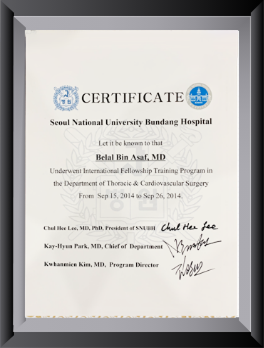
Patients searching for chest wall tumour treatment in Delhi are often surprised to learn that the region's most experienced thoracic surgical team is a short drive away rather than inside the city itself. Dr. Belal Bin Asaf is Director of the Institute of Chest Surgery, Chest Onco-Surgery & Lung Transplantation at Medanta Hospital, Noida (Sector 50) — the centre most Delhi-based patients are directed to for chest wall concerns. His sub-specialisation spans Robotic Thoracic Surgery, VATS, Lung Cancer, and Myasthenia Gravis & Thymoma treatment, built on a fellowship in Thoracic Surgery at Seoul National University Bundang Hospital, South Korea.
With 15+ years of focused thoracic surgery practice, Dr. Belal Bin Asaf has become one of the few names Delhi patients are pointed to when they ask who the best doctor for chest wall tumour in Delhi is. As a chest wall tumor specialist Delhi residents can reach in well under an hour, he brings tertiary-level diagnostic and surgical expertise that is otherwise hard to find within a single coordinated unit in the city.
To be transparent: there is no separate Medanta clinic address inside Delhi city limits. What Delhi residents get instead is a straightforward commute to a fully equipped thoracic surgery unit just across the Noida–Delhi border. Patients from East Delhi, South Delhi, Noida-facing colonies, and areas along the DND Flyway typically reach Medanta's Sector 50 Noida campus in well under an hour, making it a practical choice rather than a distant referral. Many patients describe it as "closer than it sounds" once they've made the trip once for a consultation.
A chest wall tumour is any abnormal growth developing in the ribs, breastbone, collarbone, shoulder blade, cartilage, or the muscle and soft tissue layers covering the chest cage. These masses range from harmless, slow-growing lesions to aggressive cancers, and the only reliable way to tell them apart is proper imaging followed by tissue sampling — appearance and location alone are not enough to judge whether a lump is dangerous.
The typical first sign is a lump or swelling on the chest that a patient or family member notices while bathing, dressing, or during routine touch. It may be painless initially, but as the tumour enlarges, aching pain, tenderness over the affected rib or bone, and in more advanced cases, breathlessness on exertion can develop. A swelling that keeps growing over several weeks, rather than staying the same size, is the clearest signal that it needs specialist evaluation rather than watchful waiting at home.
Chest wall tumours are grouped as benign — such as osteochondroma, chondroma, fibrous dysplasia, and lipoma, which are generally cured with local removal — and malignant, which include chondrosarcoma, Ewing sarcoma, and desmoid tumours (locally invasive but low-metastasis-risk). Less commonly, the chest wall can be the site of a metastatic deposit from a cancer elsewhere in the body, which is why full-body imaging is sometimes needed alongside local scans.
Work-up begins with a chest X-ray and CT scan to characterise the tumour's size and bone involvement, with MRI added for detailed soft-tissue mapping when required. A core needle biopsy confirms the exact diagnosis, and a PET-CT is used when malignancy is suspected, to check for spread before surgery is finalised. Treatment for both benign and malignant tumours centres on wide surgical excision with clean margins; when a significant portion of the rib cage or sternum is removed, chest wall reconstruction using mesh, plating, or flap techniques rebuilds structural support. Wherever the tumour's location and size permit, Dr. Belal Bin Asaf applies the same VATS or robotic-assisted methods used in chest wall tumor surgery Delhi patients undergo, keeping incisions smaller and recovery faster. Malignant cases are reviewed by a multidisciplinary tumour board that coordinates any chemotherapy or radiation needed after surgery.
With over 15 years focused specifically on thoracic and chest wall surgery, and recognition as the first surgeon in India to perform a robotic subxiphoid thymectomy, Dr. Belal Bin Asaf brings a level of sub-specialised expertise that is difficult to find within Delhi's general surgical setups. Delhi patients benefit from a single, coordinated centre — imaging, biopsy, tumour board discussion, and surgery all happen at Medanta Noida rather than being split across multiple hospitals across the city.
If a chest wall lump has appeared or been growing, don't let the short distance to Noida be a reason to delay. Book a consultation with Dr. Belal Bin Asaf at Medanta Hospital, Sector 50, Noida, and get a specialist opinion within a single accessible trip from Delhi.
Prefer to book a consultation online right away? Dr. Belal Bin Asaf also sees patients for this condition in Noida and Gurgaon. Learn more about his full practice as thoracic surgeon in Delhi.

Medically Written & Reviewed By
Director, Institute of Chest Surgery, Chest Onco-Surgery & Lung Transplantation — trained at AIIMS, New Delhi, with a Thoracic Surgery fellowship at Seoul National University Bundang Hospital, South Korea; first surgeon in India to perform a Robotic Subxiphoid Thymectomy. View full credentials & experience →


Morning: 10:00AM - 2:00PM
Evening 4:00PM - 6:00PM(Mon to Sat)


