

Dr. Belal Bin Asaf
Thoracic (Chest) Surgeon
Director, Institute of Chest Surgery,
Chest Onco-Surgery & Lung Transplantation, Medanta Hospital

-
 [email protected]
-
Follow Us:


Dr. Belal Bin Asaf
Thoracic (Chest) Surgeon
Director, Institute of Chest Surgery,
Chest Onco-Surgery & Lung Transplantation, Medanta Hospital
[email protected]


Esophageal cancer affects the food pipe — the muscular tube that carries food from the throat to the stomach — and its outcomes depend heavily on how early it is caught and how the treatment plan is built. Patients searching for esophageal cancer treatment in Noida can consult Dr. Belal Bin Asaf, Director of the Institute of Chest Surgery, Chest Onco-Surgery & Lung Transplantation at Medanta Superspecialty Hospital, Noida (Sector 50). Dr. Belal trained as a Clinical Registrar in General Thoracic Surgery at AIIMS, New Delhi, and has since built a practice spanning more than 15 years, with a focused specialization in Robotic Thoracic Surgery, VATS, Lung Cancer, and Myasthenia Gravis & Thymoma treatment.
As an esophageal cancer doctor in Noida, Dr. Belal manages the surgical component of esophageal cancer care — including minimally invasive and robotic-assisted esophagectomy — for residents across the NCR, working closely with oncology and gastroenterology colleagues to plan the right sequence of treatment for each patient.
Two distinct types of esophageal cancer are seen in clinical practice, and knowing which one a patient has shapes the entire treatment conversation. Squamous cell carcinoma develops from the flat cells lining the esophagus and is strongly associated with smoking, alcohol use, and repeated exposure to very hot beverages or food; it tends to occur in the upper and middle portions of the esophagus. Adenocarcinoma, by contrast, arises from glandular changes usually triggered by long-standing acid reflux (GERD) and a related condition called Barrett's esophagus, where the lower esophageal lining is altered by years of acid exposure; this type is more commonly found in the lower esophagus, closer to the stomach. Both types require different diagnostic vigilance but are approached through the same structured staging and treatment pathway.
The hallmark symptom is dysphagia — difficulty swallowing that typically starts with solid foods getting stuck and, as it progresses, extends to liquids as well. Alongside this, patients often report unexplained weight loss, a dull ache or discomfort behind the breastbone, regurgitation of food shortly after eating, and sometimes hoarseness of voice if the cancer affects nearby nerves. Because early symptoms can be mild or mistaken for routine acid reflux, persistent swallowing difficulty lasting more than two to three weeks should never be ignored, particularly in patients over 50 or those with a long history of reflux or tobacco use.
An upper GI endoscopy with biopsy remains the primary tool for confirming esophageal cancer — a thin camera examines the esophageal lining directly and tissue samples are taken for laboratory confirmation. Once diagnosed, staging determines how far the disease has spread. CT scans of the chest and abdomen map out the tumour's extent and check for spread to nearby organs, while a PET-CT scan screens the whole body for distant metastasis. Endoscopic ultrasound (EUS) adds a further layer of precision, measuring exactly how deep the tumour has invaded the esophageal wall and evaluating nearby lymph nodes — information that is critical for deciding whether surgery alone will suffice or whether chemotherapy should come first.
Treatment is stage-dependent. Very early tumours confined to the inner lining may be managed with endoscopic resection or surgery alone. Locally advanced disease generally requires neoadjuvant chemotherapy or chemoradiation to shrink the tumour before surgical removal. The surgical procedure itself — esophagectomy — involves removing the diseased segment of the esophagus and reconstructing the digestive tract, most often using the stomach. Dr. Belal performs this through minimally invasive and robotic-assisted approaches wherever clinically appropriate, which, compared to traditional open surgery, are associated with smaller incisions, reduced blood loss, and faster return to normal swallowing and daily activity. Advanced or metastatic disease is handled primarily with systemic therapy, and a multidisciplinary tumour board — bringing together medical oncology, gastroenterology, and thoracic surgery — reviews each case to tailor the sequence of treatment. Because swallowing is directly affected by the disease, nutritional support and dietary planning run alongside every stage of treatment.
Dr. Belal Bin Asaf brings a rare combination to esophageal cancer care in Noida: dedicated thoracic onco-surgery training, hands-on robotic surgical expertise (he was the first surgeon in India to perform a Robotic Subxiphoid Thymectomy), and a treatment philosophy built around minimally invasive recovery. Esophagectomy is a technically demanding operation, and outcomes are closely tied to surgeon volume and experience with complex thoracic anatomy — both areas where his practice is concentrated. Being based at a full-service tertiary hospital also means imaging, oncology, and post-surgical nutritional support are coordinated under one roof rather than across multiple centres. It's this combination — dedicated training, robotic surgical volume, and integrated hospital infrastructure — that leads many families to regard him as the best oncologist for esophageal cancer in Noida and as a go-to esophageal cancer specialist in Noida for complex, surgically-managed cases.
Medanta Hospital, Sector 50, Noida — the esophageal cancer hospital in Noida trusted by patients across the region — is positioned to serve patients across the Noida–Greater Noida–Ghaziabad corridor, including those travelling in from Indirapuram, Vaishali, and neighbouring sectors along the Noida Expressway. The hospital's location keeps travel time manageable for patients who need repeated visits for pre-treatment workup, chemotherapy cycles, and post-surgical follow-up — an important practical consideration in a treatment journey that spans several months.
If you or a family member is experiencing persistent swallowing difficulty, unexplained weight loss, or has been advised to pursue esophageal cancer evaluation, an early consultation can make a meaningful difference to treatment options and outcomes. Contact Dr. Belal Bin Asaf's team at Medanta Hospital, Sector 50, Noida to schedule an assessment and discuss the most appropriate diagnostic and treatment path for your condition.
Prefer to book a consultation online right away? Dr. Belal Bin Asaf also sees patients for this condition in Delhi and Gurgaon. Learn more about his full practice as thoracic surgeon in Noida.

Medically Written & Reviewed By
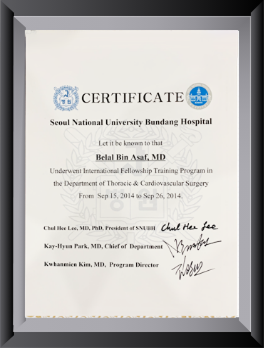
Director, Institute of Chest Surgery, Chest Onco-Surgery & Lung Transplantation — trained at AIIMS, New Delhi, with a Thoracic Surgery fellowship at Seoul National University Bundang Hospital, South Korea; first surgeon in India to perform a Robotic Subxiphoid Thymectomy. View full credentials & experience →


Morning: 10:00AM - 2:00PM
Evening 4:00PM - 6:00PM(Mon to Sat)


