

Dr. Belal Bin Asaf
Thoracic (Chest) Surgeon
Director, Institute of Chest Surgery,
Chest Onco-Surgery & Lung Transplantation, Medanta Hospital

-
 [email protected]
-
Follow Us:


Dr. Belal Bin Asaf
Thoracic (Chest) Surgeon
Director, Institute of Chest Surgery,
Chest Onco-Surgery & Lung Transplantation, Medanta Hospital
[email protected]
Dr. Belal Bin Asaf | Director, Institute of Chest Surgery, Chest Onco-Surgery & Lung Transplantation | Medanta Noida
A lung nodule, suspicious CT scan or possible diagnosis of lung cancer can raise urgent questions. The most important next step is accurate assessment—not an assumption that every suspicious shadow is cancer or that every cancer requires surgery. Effective treatment depends on the tumour type, stage, molecular characteristics and the patient’s overall fitness.
Dr. Belal Bin Asaf is a thoracic surgeon with more than 15 years of surgical experience. He provides scheduled specialist consultations as lung cancer Specialist in Srinagar for patients seeking evaluation of lung nodules, an opinion on a confirmed lung cancer diagnosis or assessment for minimally invasive lung surgery. Definitive investigations and treatment may be arranged at Medanta Hospital, Noida, when appropriate.
Lung cancer develops when abnormal cells grow uncontrollably in the lung. The two broad categories are non-small cell lung cancer (NSCLC), accounting for most cases, and small cell lung cancer (SCLC), which typically behaves more aggressively and follows a different treatment pathway.
NSCLC includes adenocarcinoma, squamous cell carcinoma and other less common subtypes. Early lung cancers may cause no symptoms and are sometimes detected incidentally on imaging. A nodule on CT is not automatically cancer: infections, scars and benign lesions can look similar.
These symptoms are not specific to cancer. However, persistent or unexplained symptoms merit medical evaluation. Significant hemoptysis, severe breathlessness or rapidly worsening symptoms require prompt hospital assessment.
Tobacco smoking is the leading risk factor, but lung cancer also occurs in people who have never smoked. Risk may be influenced by second-hand smoke, occupational exposures such as asbestos, radon exposure, air pollution, prior chest irradiation, family history and certain chronic lung diseases. No single risk factor reliably excludes or confirms cancer.
The specialist reviews the actual CT images—not only the written report—along with nodule size, growth, density, location, smoking history, symptoms and other risk factors. Depending on probability of malignancy, an indeterminate nodule may require interval imaging, further testing or biopsy rather than immediate surgery.
Diagnostic chest CT helps define the lesion and its relationship to adjacent structures. PET-CT is often used for staging potentially curable NSCLC and for evaluating suspected spread, but inflammatory disease and tuberculosis may also cause PET uptake. A PET-positive lymph node does not automatically prove cancer spread.
Biopsy may be performed through bronchoscopy, navigational techniques, endobronchial ultrasound (EBUS), CT-guided needle sampling or another appropriate method. The safest, highest-yield route depends on the location and the information needed. In selected very high-probability, operable nodules, surgical diagnosis may be appropriate after multidisciplinary review.
When imaging or tumour characteristics indicate a risk of nodal involvement, EBUS-guided sampling or another invasive staging technique may be needed—even when PET findings are inconclusive. Accurate nodal staging prevents inappropriate surgery and guides systemic treatment.
For appropriate NSCLC patients, tumour tissue is assessed for actionable genetic alterations, such as EGFR and ALK, and other clinically relevant biomarkers. PD-L1 testing helps inform immunotherapy decisions. Testing is especially important in advanced disease and may also influence perioperative or postoperative treatment in resectable disease.
Before lung resection, patients generally undergo pulmonary function tests, including FEV1 and DLCO, assessment of predicted postoperative function and appropriate cardiac evaluation. Selected patients may need exercise testing. Treatment should balance cancer control with preservation of functional lung reserve.
NSCLC is staged according to tumour extent, lymph node involvement and distant spread (TNM). The brief descriptions below are simplified; exact management depends on the full clinical stage, resectability and biomarkers.
Cancer is confined to the lung without regional nodal spread. Surgery is often preferred in fit patients; stereotactic body radiotherapy (SBRT) is an important potentially curative alternative for patients who are medically inoperable or select those who decline surgery.
The tumour may be larger or involve selected nearby lymph nodes. Surgery is frequently part of treatment when the disease is resectable, but chemotherapy, targeted therapy and/or immunotherapy before or after surgery may be indicated depending on the exact stage and tumour biology.
This is a heterogeneous category. Selected patients with potentially resectable disease may benefit from multidisciplinary plans involving systemic therapy and surgery. Unresectable disease is commonly treated with chemoradiation and, when eligible, consolidation immunotherapy or biomarker-directed treatment.
Cancer has spread to distant sites or meets other metastatic criteria. Treatment is primarily systemic and guided by molecular biomarkers, PD-L1 status and clinical fitness. Targeted treatments and immunotherapy can provide meaningful and sometimes prolonged disease control; radiotherapy or surgery may be considered for carefully selected situations or symptoms.
Small cell lung cancer is generally discussed separately using limited-stage or extensive-stage disease and is usually treated with systemic therapy, radiotherapy and, in appropriate settings, immunotherapy. Surgery is reserved for uncommon, carefully staged early cases.
Anatomical lung resection with systematic lymph node assessment remains the most preferred treatment option wherever feasible for early stage Lung Cancer. It is an important potentially curative treatment for resectable NSCLC. Lobectomy (removal of the lobe of lung containing the tumour) remains a standard operation for most tumours. Anatomical segmentectomy is appropriate for selected small, peripheral, node-negative cancers when oncological margins and lymph node assessment are adequate. More extensive operations—including sleeve resections or pneumonectomy—may be necessary in selected centrally located cancers.
Video-assisted thoracoscopic surgery (VATS) and robotic-assisted thoracic surgery use small incisions and specialised instruments. For suitable patients, minimally invasive surgery may reduce postoperative pain, complications and hospital stay compared with thoracotomy. Neither approach should compromise margin clearance or lymph node assessment. Open surgery remains appropriate for some complex tumours.
Depending on the stage and biomarkers, the multidisciplinary team may recommend platinum-based chemotherapy, immunotherapy with chemotherapy before surgery, additional treatment after surgery, or biomarker-directed postoperative therapy. These decisions are not interchangeable: an EGFR-mutant or ALK-rearranged tumour, for example, may follow a different evidence-based plan from a tumour without those alterations.
SBRT is an established curative-intent option for selected early-stage NSCLC patients who cannot undergo surgery for medical reasons i.e. those who are not medically fit for surgery. For many unresectable locally advanced stage III cancers, combined chemoradiation is standard, followed by additional systemic treatment when appropriate.
Therapy may include targeted drugs for actionable mutations, immunotherapy, chemotherapy, radiotherapy for symptoms and supportive or palliative care integrated early. The aim is to improve survival, control symptoms and maintain quality of life. Molecular testing should be completed when clinically feasible before choosing first-line systemic treatment.
A lung cancer treatment plan should ideally involve thoracic surgery, medical oncology, radiation oncology, pulmonology, pathology, radiology and nuclear medicine. A potentially operable lung tumour should not be labelled “surgical” purely because of its size, nor “inoperable” solely because a mediastinal lymph node appears PET-positive. Tissue confirmation, staging, patient fitness and current treatment options matter.
After surgery, most patients are encouraged to mobilise early and perform breathing exercises. Hospital stay, chest-drain duration and return to routine activities vary depending on the operation, lung function, complications and general condition. Some patients return to light activities within weeks, but there is no reliable universal timetable. Follow-up includes pathology review, discussion of additional treatment where needed, and scheduled surveillance chest CT.
Avoiding tobacco and stopping smoking provide the greatest opportunity to reduce lung cancer risk. For people at sufficiently high risk, annual low-dose CT screening can reduce lung cancer mortality. As one established example, USPSTF recommends annual screening for adults aged 50–80 years with at least 20 pack-years who currently smoke or quit within the previous 15 years; eligibility should be adapted to applicable clinical guidance and individual risk. Low-dose CT screening is for people without symptoms, not a substitute for diagnostic evaluation of symptoms or an abnormal scan.
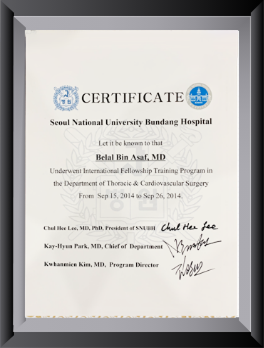
Dr. Belal Bin Asaf is Director of the Institute of Chest Surgery, Chest Onco-Surgery & Lung Transplantation at Medanta Hospital, Noida. His thoracic surgical experience includes minimally invasive lung resections, lobectomy, segmentectomy and complex thoracic operations. His training includes AIIMS, New Delhi, and a thoracic surgery fellowship at Seoul National University Bundang Hospital, South Korea.
The purpose of consultation is to clarify the diagnosis and stage, assess whether surgery is appropriate and help patients navigate multidisciplinary treatment. Not every suspicious lung lesion needs removal, and not every patient with confirmed lung cancer benefits from an operation.
This is a visiting specialist consultation for review of scans, pathology, previous treatment and treatment planning. Advanced investigations and surgery, when required and available, may be arranged at Medanta Hospital, Noida. The Srinagar clinic should not be described as a lung cancer surgical facility.
Please bring existing CT and PET-CT images, reports, pathology slides/blocks if available, molecular results, pulmonary function tests, discharge summaries and a list of medicines.
No. Many nodules are benign. Risk assessment considers imaging appearance, size, growth and patient factors. Some require surveillance rather than biopsy or surgery.
Some early-stage and selected locally advanced lung cancers can be treated with curative intent. Outcomes depend on stage, biology, fitness and treatment response.
No. Surgery is important for suitable resectable NSCLC, but radiotherapy, systemic therapy or combinations may be better for other patients.
Both are minimally invasive approaches. The most important considerations are oncological adequacy, safe execution, patient-specific anatomy and team experience—not the technology label.
PET-CT estimates the likelihood of spread; EBUS can obtain tissue from mediastinal lymph nodes when invasive confirmation is indicated.
Yes. Smoking is the major risk factor, but never-smokers can develop lung cancer and should not have persistent symptoms dismissed.
Not necessarily. Additional treatment depends on pathologic stage, resection findings, biomarkers and multidisciplinary review.
Yes, during the scheduled visiting consultation, subject to confirmation. Treatment requiring specialist facilities may be coordinated in Noida.
If you have a suspicious lung nodule, biopsy-confirmed lung cancer or questions about whether surgery is appropriate, arrange a specialist review. Early, accurate assessment can avoid unnecessary procedures and delays in appropriate treatment.
For appointment details, confirm the next Srinagar OPD date and location. Patients needing more urgent assessment may arrange consultation through Medanta Hospital, Noida. Severe breathlessness, significant bleeding or other acute deterioration requires immediate local emergency care.
See the full thoracic surgeon in Srinagar OPD details, or book a consultation online.
Patient information only. Treatment decisions must be individualised by the treating multidisciplinary team.

Medically Written & Reviewed By
Director, Institute of Chest Surgery, Chest Onco-Surgery & Lung Transplantation — trained at AIIMS, New Delhi, with a Thoracic Surgery fellowship at Seoul National University Bundang Hospital, South Korea; first surgeon in India to perform a Robotic Subxiphoid Thymectomy. View full credentials & experience →


Morning: 10:00AM - 2:00PM
Evening 4:00PM - 6:00PM(Mon to Sat)


