

Dr. Belal Bin Asaf
Thoracic (Chest) Surgeon
Director, Institute of Chest Surgery,
Chest Onco-Surgery & Lung Transplantation, Medanta Hospital

-
 [email protected]
-
Follow Us:


Dr. Belal Bin Asaf
Thoracic (Chest) Surgeon
Director, Institute of Chest Surgery,
Chest Onco-Surgery & Lung Transplantation, Medanta Hospital
[email protected]


If you or a family member has been struck by sudden, knife-like chest pain followed by breathlessness, a collapsed lung — medically called pneumothorax — is one of the first possibilities a doctor will rule out. Patients across Noida, Greater Noida, and Ghaziabad searching for reliable pneumothorax treatment in Noida turn to Dr. Belal Bin Asaf, Director of the Institute of Chest Surgery, Chest Onco-Surgery & Lung Transplantation at Medanta Hospital, Sector 50, Noida — a pneumothorax doctor in Noida trained as a Clinical Registrar in General Thoracic Surgery at AIIMS, New Delhi, before going on to build a practice focused on advanced chest surgery.
With over 15 years of experience in thoracic surgery, Dr. Belal Bin Asaf specializes in Robotic Thoracic Surgery, Video-Assisted Thoracoscopic Surgery (VATS), lung cancer, and the treatment of myasthenia gravis and thymoma, in addition to managing collapsed lungs at every stage of severity. That combination of surgical depth and sub-specialization is what most patients are actually looking for when they set out to find a doctor for a collapsed lung, and it means both emergency-stage decisions and long-term surgical planning can be handled by the same doctor, at the same hospital, without being referred elsewhere.
The lungs sit inside the chest cavity, cushioned by a thin space called the pleura. Pneumothorax occurs when air escapes into this pleural space — either from a tear in the lung surface or through a wound in the chest wall — and pushes the lung away from the chest wall, causing it to partially or fully collapse. A collapsed lung cannot expand normally with each breath, which is why the condition causes such abrupt pain and breathing difficulty.
Not every pneumothorax has the same origin, and identifying the type shapes the treatment plan:
The hallmark symptom is a sudden, sharp pain on one side of the chest, often accompanied by shortness of breath that can range from mild to severe. Some patients also notice a dry cough or a feeling of tightness while breathing.
Tension pneumothorax is a true emergency: symptoms escalate quickly to severe breathing distress, a racing heart, dropping blood pressure, and bluish discoloration of the lips or skin. Without immediate treatment, it can be fatal. Anyone in Noida or the surrounding NCR belt experiencing these warning signs should reach emergency care without delay rather than waiting for a scheduled consultation.
A chest X-ray is usually the first and fastest way to confirm a collapsed lung and estimate its size. For patients with recurrent episodes, underlying lung disease, or when finer detail is needed to plan surgery, a CT scan of the chest gives a more precise picture of lung structure, blebs, and the extent of collapse.
Treatment is matched to the severity of the collapse:
With more than 15 years of experience in chest surgery and as the first surgeon in India to perform a Robotic Subxiphoid Thymectomy, Dr. Belal Bin Asaf brings advanced minimally invasive expertise to a condition that is often treated with outdated, more invasive open techniques elsewhere. At Medanta Hospital, Sector 50, Noida, patients have access to VATS-based bullectomy and pleurodesis performed with precision aimed at faster recovery, smaller scars, and a significantly reduced chance of recurrence compared to conservative management alone. It's why he is increasingly the pneumothorax specialist in Noida patients are referred to, and why many who start out searching for the best pulmonologist for pneumothorax in Noida find that a thoracic surgeon with dedicated VATS experience is the more decisive choice, especially once the collapse has recurred.
Medanta Hospital's Sector 50 location sits directly along the Noida-Greater Noida Expressway, making it a quick and familiar route for residents of Noida's sectors, Greater Noida, and Ghaziabad. It has become a well-recognized pneumothorax hospital in Noida for exactly this reason — proximity matters when a collapsed lung needs same-day assessment. Patients travelling via the FNG (Faridabad-Noida-Ghaziabad) corridor or the Noida Expressway can reach the hospital without navigating Delhi traffic, which matters when a collapsed lung needs to be assessed and, if necessary, treated with a chest tube on the same visit.
Chest pain and breathlessness should never be ignored. Whether you need an urgent evaluation or are exploring surgical options after a recurrent collapsed lung, schedule a consultation with Dr. Belal Bin Asaf at Medanta Hospital, Sector 50, Noida, to get an accurate diagnosis and a treatment plan built around your specific case.
Prefer to book a consultation online right away? Dr. Belal Bin Asaf also sees patients for this condition in Delhi and Gurgaon. Learn more about his full practice as thoracic surgeon in Noida.



Medically Written & Reviewed By
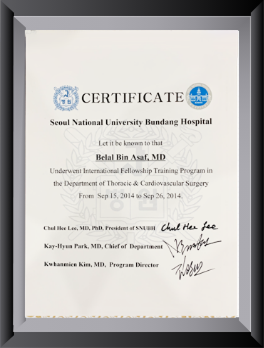
Director, Institute of Chest Surgery, Chest Onco-Surgery & Lung Transplantation — trained at AIIMS, New Delhi, with a Thoracic Surgery fellowship at Seoul National University Bundang Hospital, South Korea; first surgeon in India to perform a Robotic Subxiphoid Thymectomy. View full credentials & experience →


Morning: 10:00AM - 2:00PM
Evening 4:00PM - 6:00PM(Mon to Sat)


