

Dr. Belal Bin Asaf
Thoracic (Chest) Surgeon
Director, Institute of Chest Surgery,
Chest Onco-Surgery & Lung Transplantation, Medanta Hospital

-
 [email protected]
-
Follow Us:


Dr. Belal Bin Asaf
Thoracic (Chest) Surgeon
Director, Institute of Chest Surgery,
Chest Onco-Surgery & Lung Transplantation, Medanta Hospital
[email protected]
Sudden one-sided chest pain and breathlessness may indicate a pneumothorax (collapsed lung). The first priority is safe assessment and treatment at a nearby hospital. People with recurrent episodes, a persistent air leak or circumstances where recurrence could be especially hazardous may also benefit from specialist thoracic surgical evaluation.
Dr. Belal Bin Asaf, Director of the Institute of Chest Surgery, Chest Onco-Surgery & Lung Transplantation at Medanta Hospital, Noida, offers scheduled thoracic surgery consultations in Srinagar. With more than 15 years of thoracic surgical experience, his practice includes minimally invasive VATS procedures for pneumothorax, such as bleb/bulla resection and pleurodesis when clinically indicated.
A visiting Srinagar OPD is for planned review and follow-up—not emergency treatment for a new or worsening collapsed lung.
Pneumothorax occurs when air accumulates between the lung and chest wall (the pleural space), causing partial or complete collapse of the affected lung. It can develop spontaneously, after an injury or medical procedure, or as a complication of underlying lung disease. A pneumothorax may occur once or recur later, on the same or opposite side.
This occurs without previously recognised underlying lung disease. It is more common in younger adults, particularly people who smoke. Small subpleural blebs or bullae may be associated with the condition, but they are not necessarily demonstrable in every patient and are not the sole explanation for all episodes.
This occurs in patients with underlying lung disease, including chronic obstructive pulmonary disease (COPD), emphysema, post-tuberculosis lung damage, cystic lung diseases and selected other pulmonary disorders. Even a relatively modest collapse can produce significant breathlessness when baseline lung reserve is limited.
Pneumothorax can follow chest injury or certain procedures, including lung biopsy and central venous catheter insertion. Treatment pathways vary with the mechanism, severity and accompanying injury.
Common symptoms include sudden sharp chest pain, often on one side, shortness of breath, rapid breathing, dry cough and chest tightness. Some patients have relatively few symptoms. Examination may reveal reduced breath sounds on the affected side. Low oxygen saturation, fast heart rate or low blood pressure may indicate more serious illness.
Seek immediate emergency care for severe or increasing breathlessness, fainting, confusion, blue lips, chest pain with collapse, or rapidly worsening symptoms. A tension pneumothorax is a life-threatening emergency: it requires immediate clinical decompression without waiting for a chest X-ray when strongly suspected.
Diagnosis begins with symptoms, examination and assessment of breathing and circulation. A chest X-ray usually confirms pneumothorax in a stable patient. Bedside ultrasound may assist in experienced hands, especially in emergency settings. CT is not required for everyone; it is useful when the diagnosis is uncertain, recurrent disease needs evaluation, or underlying blebs, bullae or other lung conditions may affect treatment planning.
Treatment is selected according to symptoms, clinical stability, underlying lung disease, recurrence risk, patient preferences, and access to safe follow-up—not simply the apparent size of the pneumothorax.
Selected patients with primary spontaneous pneumothorax who are comfortable, minimally symptomatic and clinically stable may be observed with appropriate instructions and follow-up, even when the radiographic collapse is not especially small. Routine supplemental oxygen is not required in every patient with normal oxygen levels; oxygen is given when clinically indicated.
In appropriate patients with primary spontaneous pneumothorax requiring intervention, needle aspiration may remove the pleural air without leaving an intercostal chest tube in place. International guidance supports this as an initial option over routine chest-tube insertion in suitable cases.
Some centres can use a small drainage device with a one-way valve, allowing selected stable patients to be treated without routine inpatient admission. This approach requires local expertise, reliable follow-up and clear instructions for complications. It is not suitable for every patient, particularly those with significant underlying lung disease.
A chest tube is used when clinically required, including in patients with significant physiological compromise, certain secondary pneumothoraces, failed less-invasive treatment or continuing air leak. The tube allows pleural air to escape and the lung to re-expand; the need for suction is assessed individually.
Video-assisted thoracoscopic surgery (VATS) uses a camera and instruments introduced through small chest incisions. Depending on findings, it may involve stapled resection of identifiable blebs or bullae and a recurrence-prevention procedure such as pleural abrasion, pleurectomy or chemical pleurodesis. The aim is to reduce—rather than completely eliminate—the risk of future pneumothorax. The exact technique is individualised; evidence does not establish one pleurodesis approach as best for every patient.
Chemical pleurodesis through a chest drain may be considered in selected patients, especially with secondary spontaneous pneumothorax. Persistent air leaks in patients unfit for surgery sometimes require additional approaches, such as an autologous blood patch or selected endobronchial therapies.
A thoracic surgical opinion is especially relevant following a second pneumothorax on the same side or a first pneumothorax on the opposite side, as well as in patients with persistent air leakage, failure of lung re-expansion, bilateral pneumothoraces, spontaneous haemopneumothorax or a first episode with tension or major physiological compromise. A first episode may also justify an early surgical discussion when avoiding recurrence is a high priority—for example, certain pilots, divers or other high-risk professionals.
Surgery is not automatically necessary after every first episode. Conversely, it need not always be postponed until a second or third episode. The decision should balance recurrence prevention against operative risks, potential long-term pain or altered sensation and the patient’s circumstances.
A previous spontaneous pneumothorax increases the chance of another episode, although recurrence risk varies between individuals. Surgery and pleurodesis can lower that risk but cannot promise a permanent cure. Smoking cessation is one of the most important measures to reduce recurrence risk. Repeat episodes or prolonged air leaks deserve a tailored thoracic surgery review rather than repeated treatment without reassessment.
Recovery varies with the type of pneumothorax, treatment received and underlying lung health. After VATS, patients are encouraged to mobilise early, perform breathing exercises and follow wound and chest-drain advice. Pain, fatigue and the time needed to resume work differ substantially; a universal one- or two-week recovery promise is not appropriate. Follow-up usually includes clinical review and imaging to document lung re-expansion.
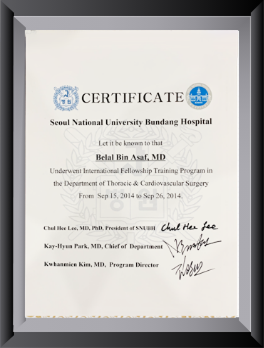
Dr. Belal Bin Asaf is a thoracic surgeon with extensive experience in VATS and advanced lung surgery. His clinical approach focuses on identifying which patients can be managed safely without surgery and which may benefit from an operation to address persistent air leakage or reduce future recurrence. He trained in General Thoracic Surgery at AIIMS, New Delhi, and undertook a thoracic surgery fellowship at Seoul National University Bundang Hospital, South Korea.
The assessment may include reviewing previous chest X-rays and CT scans, discussing the details of prior episodes and treatments, and selecting an appropriate follow-up or operative strategy in collaboration with the patient’s local treating team.
Visiting OPD: New City Hospital, Tengpora Bypass, Srinagar. Please confirm the date, venue and appointment availability before travel by calling on 9818045855
The Srinagar clinic is for planned consultation, review of reports and follow-up. Patients who require VATS or other advanced thoracic procedures can be assessed for treatment at Medanta Hospital, Noida. A new pneumothorax or acute worsening requires emergency treatment at the nearest capable hospital—not a wait for the monthly OPD.
No. Selected stable patients can be managed conservatively, while needle aspiration or ambulatory treatment is appropriate for others. Chest drainage is required in particular clinical situations.
No. Surgery is typically considered for recurrence, persistent air leak, failure of lung re-expansion or situations where preventing another episode is especially important.
Yes. Surgery substantially reduces recurrence risk in appropriately selected patients, but no technique guarantees zero recurrence.
Not routinely. CT may be appropriate for uncertainty, atypical presentations, recurrent episodes or operative planning.
Usually only after full radiographic resolution and the recommended waiting period; current BTS advice specifies at least 7 days after an X-ray confirms complete resolution.
No. Acute collapse, especially with chest pain or breathing difficulty, needs prompt assessment at a nearby emergency department. The Srinagar visit is for scheduled thoracic surgical assessment and follow-up.
If you have experienced recurrent pneumothorax, ongoing air leakage, a difficult-to-resolve collapsed lung or need an opinion about VATS and pleurodesis, arrange a thoracic surgical consultation. Bring previous chest imaging, discharge summaries and details of chest-tube or other treatment.
See the full thoracic surgeon in Srinagar OPD details, or book a consultation online.
For sudden chest pain, severe breathlessness or suspected recurrent pneumothorax, seek emergency care immediately instead of waiting for a planned clinic appointment.

Medically Written & Reviewed By
Director, Institute of Chest Surgery, Chest Onco-Surgery & Lung Transplantation — trained at AIIMS, New Delhi, with a Thoracic Surgery fellowship at Seoul National University Bundang Hospital, South Korea; first surgeon in India to perform a Robotic Subxiphoid Thymectomy. View full credentials & experience →


Morning: 10:00AM - 2:00PM
Evening 4:00PM - 6:00PM(Mon to Sat)


