

Dr. Belal Bin Asaf
Thoracic (Chest) Surgeon
Director, Institute of Chest Surgery,
Chest Onco-Surgery & Lung Transplantation, Medanta Hospital

-
 [email protected]
-
Follow Us:


Dr. Belal Bin Asaf
Thoracic (Chest) Surgeon
Director, Institute of Chest Surgery,
Chest Onco-Surgery & Lung Transplantation, Medanta Hospital
[email protected]


If you or a family member has been coughing up cupfuls of sputum every day, or has been treated for "recurrent chest infections" more times than you can count, it may be worth asking your doctor about bronchiectasis. For residents of Noida, Greater Noida, and Ghaziabad in search of trusted bronchiectasis treatment in Noida, expert care is available at Medanta Hospital, Sector 50, under Dr. Belal Bin Asaf, Director of the Institute of Chest Surgery, Chest Onco-Surgery & Lung Transplantation at Medanta Hospital, Noida (Sector 50).
Dr. Belal Bin Asaf trained as a Clinical Registrar in General Thoracic Surgery at AIIMS, New Delhi, and has since built over 15 years of dedicated thoracic surgery experience, with a special focus on robotic thoracic surgery, VATS, lung cancer, and myasthenia gravis & thymoma treatment. He was also the first surgeon in India to perform a robotic subxiphoid thymectomy, a distinction that reflects the surgical precision he brings to complex chest conditions such as bronchiectasis requiring resection.
Bronchiectasis is a chronic lung condition in which the airways (bronchi) become abnormally and permanently widened and scarred. Once this damage occurs, the airways lose their ability to clear mucus efficiently, so secretions pool inside them. This stagnant mucus becomes a breeding ground for bacteria, setting up a cycle of infection, inflammation, and further airway damage. Unlike a simple chest infection that resolves completely, bronchiectasis is a structural, irreversible change to the airways that requires ongoing, long-term management.
In North India, the single most common cause remains post-infective damage — severe childhood pneumonia or, very importantly, prior pulmonary tuberculosis, which continues to be a leading driver of bronchiectasis in this region. Other recognised causes include:
The hallmark symptom is a chronic, productive cough with large volumes of daily sputum — often described by patients as "cupfuls" produced first thing in the morning. Other symptoms include recurrent chest infections that keep returning despite antibiotics, progressive breathlessness, persistent fatigue, wheezing, and, in more advanced or severe disease, coughing up blood (hemoptysis). Any patient in Noida or Greater Noida who has had three or more chest infections in a year, or a history of treated tuberculosis with ongoing cough, should be evaluated for bronchiectasis.
A high-resolution CT (HRCT) scan of the chest is the gold-standard diagnostic test — it clearly shows the dilated, thickened airways characteristic of bronchiectasis and helps determine how many lung segments are involved. At Medanta Hospital, Sector 50 — a leading bronchiectasis hospital in Noida — this is paired with a sputum culture to identify the specific bacteria colonising the airways (which guides antibiotic selection), pulmonary function tests to assess lung capacity, and a targeted search for the underlying cause — including immunoglobulin levels, ABPA testing, and a review of any prior TB treatment history.
For the majority of patients, bronchiectasis is managed medically. This includes regular airway clearance techniques and chest physiotherapy to help mobilise and expel trapped mucus, targeted antibiotic courses during flare-ups, bronchodilator therapy to ease breathlessness, and treatment directed at the underlying cause where one is identified — for example, antifungal therapy for ABPA.
Surgery is not the first option, but it does have an important role in carefully selected cases: patients with disease localised to one lobe or segment of the lung, those with recurrent severe hemoptysis that medical therapy cannot control, or those whose destroyed lung segment continues to trigger infections despite optimal medical care. In such patients, Dr. Belal Bin Asaf — a bronchiectasis specialist in Noida with extensive experience in complex airway disease — performs minimally invasive resections, including VATS (video-assisted thoracoscopic surgery) and robotic lobectomy or segmentectomy, to remove the damaged segment while preserving as much healthy lung tissue as possible.
Dr. Belal Bin Asaf brings over 15 years of dedicated thoracic surgery experience to Medanta Hospital, Sector 50, Noida, and was the first surgeon in India to perform a robotic subxiphoid thymectomy — a marker of the advanced surgical precision he applies across complex chest conditions, including bronchiectasis requiring resection. For patients whose disease is confined to a specific segment, having a surgeon experienced in both open and robotic/VATS lung resection means the option of a minimally invasive approach, with a smaller incision, less post-operative pain, and a faster return to normal life, when surgery genuinely is the right choice.
Medanta Hospital, Sector 50, Noida, sits directly along the Noida Expressway, making it a straightforward drive for patients from Sector 50 itself, as well as from Greater Noida, Noida Extension, Indirapuram, and Vaishali in Ghaziabad. Many patients begin their search online looking for the best pulmonologist for bronchiectasis in Noida; because bronchiectasis can, in a subset of cases, require surgical rather than purely medical management, having direct access to a thoracic surgical specialist alongside pulmonology input is a distinct advantage of the Medanta Noida setup. Given how frequently bronchiectasis patients need follow-up visits for physiotherapy guidance, sputum monitoring, and periodic imaging, having a chest surgery centre within easy reach of the Noida–Ghaziabad corridor meaningfully reduces the burden of long-term care.
If chronic cough, daily sputum, or recurring chest infections are affecting your life, don't wait for the next flare-up. Schedule a consultation with Dr. Belal Bin Asaf at Medanta Hospital, Sector 50, Noida, for a thorough evaluation and a treatment plan tailored to your condition.
Prefer to book a consultation online right away? Dr. Belal Bin Asaf also sees patients for this condition in Delhi and Gurgaon. Learn more about his full practice as thoracic surgeon in Noida.

Medically Written & Reviewed By
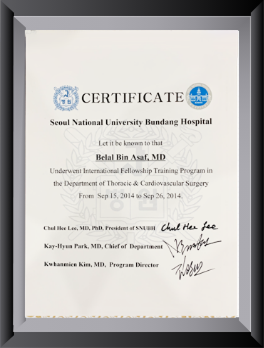
Director, Institute of Chest Surgery, Chest Onco-Surgery & Lung Transplantation — trained at AIIMS, New Delhi, with a Thoracic Surgery fellowship at Seoul National University Bundang Hospital, South Korea; first surgeon in India to perform a Robotic Subxiphoid Thymectomy. View full credentials & experience →


Morning: 10:00AM - 2:00PM
Evening 4:00PM - 6:00PM(Mon to Sat)


