

Dr. Belal Bin Asaf
Thoracic (Chest) Surgeon
Director, Institute of Chest Surgery,
Chest Onco-Surgery & Lung Transplantation, Medanta Hospital

-
 [email protected]
-
Follow Us:


Dr. Belal Bin Asaf
Thoracic (Chest) Surgeon
Director, Institute of Chest Surgery,
Chest Onco-Surgery & Lung Transplantation, Medanta Hospital
[email protected]


Delhi residents referred for a "lung nodule" or "pulmonary nodule" after a routine chest X-ray or CT scan often start searching for the best doctor for lung nodules in Delhi — someone who can be reached quickly and trusted completely. While Dr. Belal Bin Asaf does not run a clinic within Delhi city limits, he is one of the NCR's most experienced thoracic surgeons for exactly this problem: Director of the Institute of Chest Surgery, Chest Onco-Surgery & Lung Transplantation at Medanta Hospital, Noida (Sector 50), which sits just across the Delhi-Noida border, a short drive via the DND Flyway for most Delhi residents. This page explains what a lung nodule finding means and how Delhi patients can access expert lung nodules treatment in Delhi without the wait times or ambiguity that often follow such a report.
As a lung nodule specialist Delhi families are frequently referred to, Dr. Belal Bin Asaf combines more than 15 years of thoracic surgery experience with early training as a Clinical Registrar in General Thoracic Surgery at AIIMS, New Delhi. He now leads a practice focused on Robotic Thoracic Surgery, VATS, lung cancer, and myasthenia gravis & thymoma treatment — precisely the sub-specialist skill set behind decisive, guideline-based lung nodule treatment Delhi patients can rely on instead of an open-ended referral.
A lung nodule is a small, well-defined spot — typically less than 3 cm — that shows up on a chest X-ray or CT scan, often as an incidental finding during imaging done for something else entirely, such as a pre-travel health check, a workplace screening, or a scan for a cough or chest infection. In Delhi's population, a large share of these nodules turn out to be residue from a past, healed tuberculosis infection or a benign calcified granuloma — findings that need no treatment at all, only correct interpretation. A minority, however, represent something that needs closer attention, which is why a specialist read of the actual scan matters more than the report line alone.
Certain factors shift a nodule's likelihood of being something serious: a history of smoking (current or past), age above 50, a personal history of any previous cancer, a family history of lung cancer, and exposure to occupational pollutants or Delhi's persistently poor air quality over many years, which some studies link to incidental pulmonary findings. None of these factors alone confirm anything — they simply help decide how closely a nodule needs to be watched or investigated.
A nodule that is small, has smooth borders, shows dense calcium on CT, and has remained unchanged across two or more scans taken a year or more apart is reassuring and usually simply monitored. On the other hand, a nodule with irregular or spiky edges, a part-solid or hazy "ground-glass" appearance, larger size, or — the clearest red flag — visible growth on a repeat scan warrants prompt, focused evaluation. Bringing along any prior scans, even from years earlier, is genuinely valuable, since comparing today's image against an old one is often what settles the question.
The workup generally begins with a high-resolution CT chest to define the nodule's exact size, shape, and density. If features suggest higher risk, a PET-CT scan may follow to assess metabolic activity. For nodules that are too small or too indeterminate to call either way, a structured surveillance protocol — repeat CT imaging at set intervals, in line with internationally accepted Fleischner Society-style guidance — is used rather than jumping straight to invasive testing. When a nodule genuinely looks suspicious, a tissue sample is obtained via CT-guided needle biopsy, navigational bronchoscopy, or, where other approaches are inconclusive, a minimally invasive VATS wedge resection that both diagnoses and treats in one sitting.
Not every nodule leads to surgery — in fact, most don't, and pulmonary nodule treatment Delhi patients receive from Dr. Belal Bin Asaf begins with the least invasive option that is medically appropriate. Small, low-risk nodules are simply tracked over time with scheduled imaging. When tissue diagnosis or definitive removal is required, Dr. Belal Bin Asaf specializes in minimally invasive VATS and robotic-assisted wedge resection or segmentectomy, techniques that remove the nodule while conserving healthy lung tissue and avoiding the large incision, extended hospital stay, and prolonged recovery associated with open chest surgery.
As Director of the Institute of Chest Surgery, Chest Onco-Surgery & Lung Transplantation at Medanta, and the first surgeon in India to perform a Robotic Subxiphoid Thymectomy, Dr. Belal Bin Asaf brings 15+ years of concentrated thoracic surgery experience to nodule cases that many general physicians would simply refer onward without a clear plan. For Delhi patients specifically, that means access to sub-specialist, robotic-capable thoracic surgery — a level of expertise that is genuinely limited within Delhi itself — reached with a manageable commute rather than a long-distance referral.
For patients coming from East Delhi, South Delhi, Noida-adjacent parts of the city, or anywhere along the DND corridor, Medanta Hospital in Sector 50, Noida is typically reachable within 30-45 minutes depending on traffic, making it one of the more accessible tertiary thoracic surgery centers for Delhi residents rather than needing to travel to a hospital deep within south or west Delhi. Patients frequently bring a CT disc obtained at a Delhi diagnostic lab directly to the consultation so it can be reviewed without repeat scanning.
If a scan report has mentioned a lung nodule and you want a specialist opinion rather than continued uncertainty, book a consultation with Dr. Belal Bin Asaf at Medanta, Noida — a short trip from most parts of Delhi for genuinely expert thoracic care.
Prefer to book a consultation online right away? Dr. Belal Bin Asaf also sees patients for this condition in Noida and Gurgaon. Learn more about his full practice as thoracic surgeon in Delhi.

Medically Written & Reviewed By
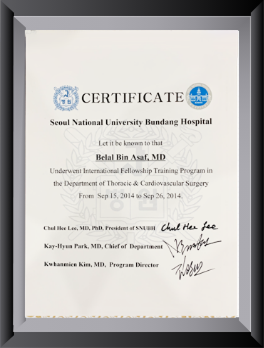
Director, Institute of Chest Surgery, Chest Onco-Surgery & Lung Transplantation — trained at AIIMS, New Delhi, with a Thoracic Surgery fellowship at Seoul National University Bundang Hospital, South Korea; first surgeon in India to perform a Robotic Subxiphoid Thymectomy. View full credentials & experience →


Morning: 10:00AM - 2:00PM
Evening 4:00PM - 6:00PM(Mon to Sat)


