

Dr. Belal Bin Asaf
Thoracic (Chest) Surgeon
Director, Institute of Chest Surgery,
Chest Onco-Surgery & Lung Transplantation, Medanta Hospital

-
 [email protected]
-
Follow Us:


Dr. Belal Bin Asaf
Thoracic (Chest) Surgeon
Director, Institute of Chest Surgery,
Chest Onco-Surgery & Lung Transplantation, Medanta Hospital
[email protected]


An incidental "nodule" or "shadow" spotted on a chest CT is one of the most frequent findings referred to thoracic specialists across the National Capital Region, and it is one of the most common reasons patients seek out a dedicated chest surgeon rather than continuing with a general physician alone. Dr. Belal Bin Asaf is Director of the Institute of Chest Surgery, Chest Onco-Surgery & Lung Transplantation at Medanta Hospital, Noida, and offers a definitive, specialist-led opinion for anyone whose scan has flagged a nodule, combining precise diagnostic evaluation with, when needed, advanced minimally invasive and robotic surgical options.
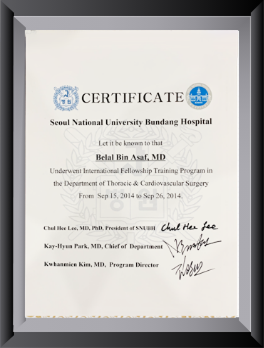
With more than 15 years of thoracic surgery experience — including a fellowship in Thoracic Surgery at Seoul National University Bundang Hospital, South Korea — Dr. Belal Bin Asaf has built his practice around Robotic Thoracic Surgery, VATS, lung cancer, and myasthenia gravis & thymoma treatment, giving nodule cases the kind of sub-specialist evaluation that is often hard to find outside a handful of centers in the region.
For patients in Gurugram seeking a definitive, specialist-led opinion, Dr. Belal Bin Asaf provides comprehensive lung nodules treatment in Gurgaon at Medanta – The Medicity, Sector 38, combining precise diagnostic evaluation with, when needed, advanced minimally invasive and robotic surgical options. A pulmonary nodule is a small, rounded density in the lung — usually under 3 cm — detected on chest imaging. Given how frequently full-body or chest CT scans are now part of executive health check-ups popular among Gurgaon's large corporate workforce, nodules are increasingly discovered incidentally in people with no symptoms at all. The reassuring reality is that most such findings are benign: healed granulomas from a past infection, or hamartomas, a common non-cancerous lung growth. Still, because a subset can represent early malignancy, every nodule warrants a structured, specialist evaluation rather than being set aside as "probably nothing."
The likelihood that a nodule needs active management, rather than simple observation, depends on a combination of factors: smoking history and intensity, patient age (risk rises notably past 50), any personal history of cancer, family history of lung cancer, and long-term exposure to environmental pollutants or occupational hazards. For Gurgaon's many long-term residents and professionals who have lived through years of variable regional air quality, this history is taken into account alongside the imaging findings, though no single factor determines the outcome on its own.
A nodule is generally reassuring when it is small, round with smooth edges, shows dense calcification on CT, and has been stable in size across scans separated by a year or more. Concerning features include irregular or spiculated borders, a part-solid or ground-glass density pattern, increasing size on serial imaging, or a larger nodule at initial detection. Because growth over time is often the clearest signal, patients are encouraged to bring any previous CT or X-ray films — even from a different hospital or years prior — so a direct comparison can be made at the first visit.
Evaluation starts with a detailed CT chest to precisely characterize the nodule's dimensions, shape, and internal density. Where risk features are present, a PET-CT scan helps assess metabolic activity that can point toward malignancy. Smaller, indeterminate nodules that don't clearly fall into a benign or high-risk category are typically managed with a defined surveillance schedule — periodic follow-up CT scans at intervals guided by internationally recognized Fleischner Society-type protocols — avoiding unnecessary invasive testing while still catching any change early. When a nodule appears genuinely suspicious, tissue diagnosis is pursued through CT-guided needle biopsy, navigational bronchoscopy, or a minimally invasive VATS wedge resection that combines diagnosis and treatment in one procedure.
Management is individualized, and pulmonary nodule treatment Gurgaon patients receive is never one-size-fits-all. Many nodules require nothing more than scheduled surveillance imaging, sparing the patient any procedure at all. When a nodule does require tissue sampling or definitive removal, Dr. Belal Bin Asaf performs VATS and robotic-assisted wedge resection or segmentectomy — keyhole techniques that remove the nodule while preserving surrounding healthy lung tissue. Compared to open thoracotomy, these approaches typically mean smaller incisions, reduced postoperative pain, and a quicker return to normal activity, which matters considerably to Gurgaon's working professionals balancing recovery with career demands.
Patients often begin their search looking for the best pulmonologist for lung nodules Gurgaon has to offer, only to learn that a nodule needing tissue diagnosis or removal is best handled by a thoracic surgical sub-specialist rather than a pulmonologist alone — which is exactly the gap a lung nodule specialist Gurgaon patients can trust fills. Based at Medanta – The Medicity, Sector 38, Gurugram, Dr. Belal Bin Asaf serves as Director of the Institute of Chest Surgery, Chest Onco-Surgery & Lung Transplantation, with more than 15 years of focused thoracic surgery experience. He holds the distinction of being the first surgeon in India to perform a Robotic Subxiphoid Thymectomy, and his surgical practice centers on robotic and VATS-based management of lung cancer, thymoma, and pulmonary nodules — meaning Gurgaon patients get sub-specialist-level nodule evaluation and, if surgery becomes necessary, access to the most advanced minimally invasive techniques available in the region.
Medanta – The Medicity in Sector 38 is one of Gurugram's most established tertiary care destinations, well connected via NH-48 and Golf Course Extension Road for patients from DLF phases, Sohna Road, Manesar, and the broader Gurugram corridor, as well as for South Delhi residents for whom Medanta Gurugram is often closer than hospitals within central or north Delhi. For DLF, Sohna Road, and Golf Course Road residents in particular, having a lung nodule doctor Gurgaon based this close by removes what would otherwise be a long referral to Delhi or Noida. Patients are welcome to bring existing CT scans from any Gurgaon-based diagnostic center directly to the consultation for review.
If a chest scan has revealed a lung nodule, don't let uncertainty sit unresolved. Book a consultation with Dr. Belal Bin Asaf at Medanta – The Medicity, Gurugram, for a precise, specialist evaluation and a management plan suited to your specific findings.
Prefer to book a consultation online right away? Dr. Belal Bin Asaf also sees patients for this condition in Noida and Delhi. Learn more about his full practice as thoracic surgeon in Gurgaon.

Medically Written & Reviewed By
Director, Institute of Chest Surgery, Chest Onco-Surgery & Lung Transplantation — trained at AIIMS, New Delhi, with a Thoracic Surgery fellowship at Seoul National University Bundang Hospital, South Korea; first surgeon in India to perform a Robotic Subxiphoid Thymectomy. View full credentials & experience →


Morning: 10:00AM - 2:00PM
Evening 4:00PM - 6:00PM(Mon to Sat)


