

Dr. Belal Bin Asaf
Thoracic (Chest) Surgeon
Director, Institute of Chest Surgery,
Chest Onco-Surgery & Lung Transplantation, Medanta Hospital

-
 [email protected]
-
Follow Us:


Dr. Belal Bin Asaf
Thoracic (Chest) Surgeon
Director, Institute of Chest Surgery,
Chest Onco-Surgery & Lung Transplantation, Medanta Hospital
[email protected]


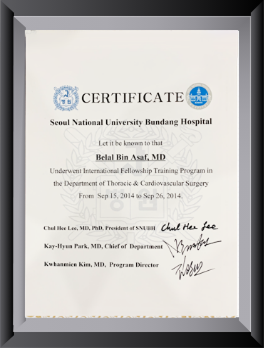
Delhi residents searching for myasthenia gravis treatment in Delhi are often surprised to learn that some of the most advanced surgical care for this condition anywhere in North India is a short drive away, not across town. Dr. Belal Bin Asaf, Director of the Institute of Chest Surgery, Chest Onco-Surgery & Lung Transplantation at Medanta Hospital, Noida (Sector 50), completed a fellowship in Thoracic Surgery at Seoul National University Bundang Hospital in South Korea after training as a Clinical Registrar in General Thoracic Surgery at AIIMS, New Delhi — training that has made him the myasthenia gravis specialist in Delhi families increasingly search for by name.
That international fellowship training, paired with 15+ years of thoracic surgery experience, is what allows Dr. Belal to work across Robotic Thoracic Surgery, VATS, lung cancer, and the surgical management of myasthenia gravis and thymoma — and, notably, to be the first surgeon in India to perform a Robotic Subxiphoid Thymectomy. This page explains the condition, how it is worked up, and what surgical treatment looks like for the many Delhi patients who choose him as their myasthenia gravis doctor in Delhi despite the short trip across the border.
Myasthenia gravis (MG) is a chronic autoimmune disease of the neuromuscular junction — the tiny gap where a nerve ending meets a muscle fibre. In MG, the body's own antibodies attack acetylcholine receptors at this junction, interfering with the chemical signal that tells muscles to contract. The defining clinical feature is fluctuating weakness: muscles tire with repeated use and recover somewhat with rest, so symptoms are often barely noticeable in the morning and pronounced by evening or after physical activity.
Delhi patients typically first notice something is wrong in the eyes — a heavy, drooping eyelid (ptosis) or episodes of double vision (diplopia) that come and go. From there, symptoms can extend to the face and throat, producing slurred or nasal speech and trouble swallowing that gets worse partway through a meal. Weakness in the shoulders, hips, or neck can make everyday tasks like lifting grocery bags or climbing stairs at a Delhi metro station noticeably harder. The most serious complication, myasthenic crisis, involves weakness of the breathing muscles and requires emergency hospital treatment — a reason not to delay evaluation once symptoms are suspected.
A central fact about MG is its close relationship with the thymus gland, a small organ behind the breastbone. About 10-15% of people with MG have a thymoma — a tumour of the thymus — while many others have thymic hyperplasia, an enlarged, overactive gland believed to fuel the abnormal antibody response. This is precisely why patients from Delhi are referred to a thoracic surgeon rather than managed by medication alone: the thymus often needs to be imaged, evaluated, and in many cases surgically removed.
Reaching an accurate diagnosis involves a combination of clinical assessment and targeted testing: a neurological exam looking for fatigable weakness, blood testing for acetylcholine receptor antibodies (and anti-MuSK antibodies if those are negative), and repetitive nerve stimulation or EMG studies to document the neuromuscular junction defect electrically, typically arranged in coordination with a neurologist for myasthenia gravis in Delhi where needed. A CT scan of the chest is essential to assess the thymus gland for thymoma or hyperplasia. Older clinics sometimes still reference the edrophonium (Tensilon) test, a rapid pharmacological test historically used to confirm the diagnosis at the bedside.
Initial treatment for most MG patients is medical: pyridostigmine to boost neuromuscular signalling, plus steroids or other immunosuppressive drugs to dampen the autoimmune attack. But medication alone doesn't remove the underlying trigger in many patients — particularly those with thymoma. This is where thymectomy, surgical removal of the thymus gland, becomes relevant, since it is associated with improved strength and higher remission rates in a large proportion of MG patients. Dr. Belal Bin Asaf was the first surgeon in India to perform a robotic subxiphoid thymectomy, a technique that removes the thymus through small incisions below the breastbone rather than splitting the sternum open. For Delhi patients, this means the difference between a traditional open surgery with a long recovery and a robotic or VATS procedure with less pain, a shorter hospital stay, and quicker return to work.
There is no substitute for experience when a nerve condition and a chest operation intersect. Dr. Belal brings 15+ years of dedicated thoracic surgery practice and is recognised as one of India's leading names in robotic and minimally invasive thymus surgery, which is why he is consistently sought out as the source of the best myasthenia gravis treatment Delhi patients can access. Delhi patients choosing him aren't settling for a nearby generalist — they are seeking out a specific, rare surgical skill set that happens to sit just across the Delhi-Noida border.
Medanta Hospital, Sector 50, Noida is one of the most accessible super-specialty hospitals for Delhi residents, particularly those in East Delhi, Central Delhi, and South Delhi. Via the DND Flyway or the Noida-Delhi border near Akshardham, the drive typically takes 30-50 minutes depending on the starting point and traffic — comparable to, or shorter than, crossing Delhi itself to reach some intra-city hospitals. Being honest about this distance matters: there is no physical Dr. Belal Bin Asaf clinic within Delhi, and no single myasthenia gravis hospital in Delhi offers this exact combination of robotic thymus expertise, so the Noida facility is close enough that it functions as the practical, nearest option for advanced MG and thymus care.
If you live in Delhi and are noticing drooping eyelids, double vision, or unusual muscle fatigue, don't wait for symptoms to worsen. Reach out to Dr. Belal Bin Asaf's team to arrange a consultation at Medanta Hospital, Sector 50, Noida, and get a clear diagnostic and treatment plan tailored to your case.
Prefer to book a consultation online right away? Dr. Belal Bin Asaf also sees patients for this condition in Noida and Gurgaon. Learn more about his full practice as thoracic surgeon in Delhi.


Medically Written & Reviewed By
Director, Institute of Chest Surgery, Chest Onco-Surgery & Lung Transplantation — trained at AIIMS, New Delhi, with a Thoracic Surgery fellowship at Seoul National University Bundang Hospital, South Korea; first surgeon in India to perform a Robotic Subxiphoid Thymectomy. View full credentials & experience →


Morning: 10:00AM - 2:00PM
Evening 4:00PM - 6:00PM(Mon to Sat)


