

Dr. Belal Bin Asaf
Thoracic (Chest) Surgeon
Director, Institute of Chest Surgery,
Chest Onco-Surgery & Lung Transplantation, Medanta Hospital

-
 [email protected]
-
Follow Us:


Dr. Belal Bin Asaf
Thoracic (Chest) Surgeon
Director, Institute of Chest Surgery,
Chest Onco-Surgery & Lung Transplantation, Medanta Hospital
[email protected]


If fatigue in your eyelids, blurred or double vision, or unexplained weakness in your arms and legs seems to worsen as the day goes on, you may be dealing with myasthenia gravis (MG) — a treatable autoimmune condition that affects how nerves communicate with muscles. Dr. Belal Bin Asaf, Director of the Institute of Chest Surgery, Chest Onco-Surgery & Lung Transplantation at Medanta Hospital, Noida (Sector 50), trained as a Clinical Registrar in General Thoracic Surgery at AIIMS, New Delhi before going on to become the first surgeon in India to perform a Robotic Subxiphoid Thymectomy. That combination of foundational training and pioneering surgical skill is the reason patients across the region search specifically for a myasthenia gravis specialist Noida can rely on for both diagnosis and definitive surgical treatment.
With 15+ years of thoracic surgery experience, Dr. Belal now leads one of the region's most comprehensive myasthenia gravis treatment in Noida programs, combining neurological medical management with advanced thymus gland surgery for patients whose MG is linked to thymoma or thymic hyperplasia. His practice today spans Robotic Thoracic Surgery, VATS, lung cancer, and the surgical management of myasthenia gravis and thymoma, making him one of the few surgeons in the region equally at home in both disciplines.
Myasthenia gravis is an autoimmune disorder in which the immune system mistakenly produces antibodies that block or destroy acetylcholine receptors at the neuromuscular junction — the point where nerve signals are supposed to trigger muscle contraction. When these receptors are damaged, muscles simply don't receive the signal to fire properly. The hallmark of MG is that weakness is fluctuating: it tends to build up with repeated use of a muscle group and ease after rest, which is why patients often notice their symptoms are mildest in the morning and worse by evening.
The presentation of MG varies from person to person, but common warning signs include drooping of one or both eyelids (ptosis), double vision (diplopia), and a voice that sounds slurred or nasal after talking for a while. Many patients describe difficulty chewing or swallowing partway through a meal, or arms that tire quickly while combing hair or reaching for objects overhead. Neck and limb weakness can affect the ability to climb stairs or rise from a chair. In more advanced or poorly controlled cases, the muscles involved in breathing can weaken — a medical emergency known as myasthenic crisis that requires immediate hospital care.
One of the most important pieces of the myasthenia gravis puzzle sits behind the breastbone: the thymus gland. Roughly 10-15% of MG patients have a thymoma, a tumour of the thymus, and a much larger proportion show thymic hyperplasia, an overactive, enlarged thymus that is thought to help drive the abnormal antibody production. Because of this link, evaluating the thymus is a routine and essential part of working up any newly diagnosed MG patient.
A confident MG diagnosis is built from several layers of testing. It typically begins with a focused clinical examination looking for fatigable weakness, followed by blood tests for acetylcholine receptor antibodies and, when those are negative, anti-MuSK antibodies. Repetitive nerve stimulation and electromyography (EMG) studies help confirm that the neuromuscular junction is the site of the problem, work that is coordinated with the best neurologist for myasthenia gravis in Noida available to the patient. A CT scan of the chest is used to check the size and appearance of the thymus gland and rule out thymoma. The older edrophonium (Tensilon) test, which produces a brief but telling improvement in strength, is still referenced in some clinical settings today.
Most patients start on medical therapy — pyridostigmine to improve neuromuscular transmission, along with steroids or steroid-sparing immunosuppressants to calm the underlying autoimmune activity. For a substantial number of patients, however, particularly those with thymoma or persistent symptoms despite medication, removing the thymus gland (thymectomy) meaningfully improves strength and can lead to long-term remission. Dr. Belal Bin Asaf is one of India's most experienced thoracic surgeons in this field and was the first in the country to perform a robotic subxiphoid thymectomy — an approach that avoids cutting through the breastbone entirely. Compared with traditional open sternotomy, robotic and VATS (video-assisted) thymectomy at his Noida centre mean smaller incisions, markedly less postoperative pain, and a faster return to normal life.
Patients travel from across Delhi NCR specifically for Dr. Belal's dual expertise — he treats MG both as a systemic neuro-autoimmune condition and as a surgical thymus problem, which means the decision about whether and when to operate is made by someone who personally performs the operation, not referred out. As a myasthenia gravis doctor in Noida with 15+ years of experience and a track record as a pioneer of minimally invasive chest surgery in India, he is able to offer robotic subxiphoid thymectomy at Medanta Noida — a technique still unavailable at most centres in the region, and one reason Medanta is regarded as a leading myasthenia gravis hospital Noida families turn to for surgical MG care.
Medanta Hospital, Sector 50, Noida sits directly along the Noida-Greater Noida Expressway corridor, making it a straightforward, traffic-light visit for residents of Sectors 62, 78, 137, and other parts of Noida, as well as Greater Noida and Ghaziabad. Patients from these areas typically reach the hospital in under 30-40 minutes, which matters for a condition like MG that often needs repeated follow-up visits, nerve conduction studies, and post-surgical review appointments.
If you or a family member in Noida is experiencing drooping eyelids, unexplained fatigue, or muscle weakness that fits this pattern, early evaluation makes a real difference in how well MG can be controlled. Contact Dr. Belal Bin Asaf's team at the myasthenia gravis clinic Noida patients trust — Medanta Hospital, Sector 50, Noida — to schedule a consultation and discuss whether medical management or thymectomy is the right path for you.
Prefer to book a consultation online right away? Dr. Belal Bin Asaf also sees patients for this condition in Delhi and Gurgaon. Learn more about his full practice as thoracic surgeon in Noida.


Medically Written & Reviewed By
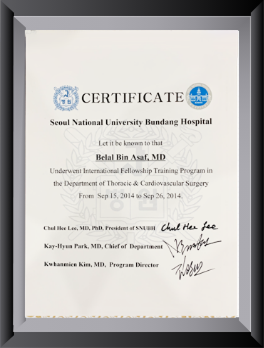
Director, Institute of Chest Surgery, Chest Onco-Surgery & Lung Transplantation — trained at AIIMS, New Delhi, with a Thoracic Surgery fellowship at Seoul National University Bundang Hospital, South Korea; first surgeon in India to perform a Robotic Subxiphoid Thymectomy. View full credentials & experience →


Morning: 10:00AM - 2:00PM
Evening 4:00PM - 6:00PM(Mon to Sat)


