
Dr. Belal Bin Asaf
Thoracic (Chest) Surgeon
Director, Institute of Chest Surgery,
Chest Onco-Surgery & Lung Transplantation, Medanta Hospital
-
 [email protected]
-
Follow Us:


Dr. Belal Bin Asaf
Thoracic (Chest) Surgeon
Director, Institute of Chest Surgery,
Chest Onco-Surgery & Lung Transplantation, Medanta Hospital
[email protected]


If you or a family member has been told a scan shows a mass in the chest near the breastbone, and the word "thymoma" has come up, it's natural to have questions about where to find reliable thymoma treatment in Noida. Dr. Belal Bin Asaf, Director of the Institute of Chest Surgery, Chest Onco-Surgery & Lung Transplantation at Medanta Superspecialty Hospital, Sector 50, Noida, trained as a Clinical Registrar in General Thoracic Surgery at AIIMS, New Delhi, before building a practice focused on Robotic Thoracic Surgery, VATS, Lung Cancer, and the treatment of Myasthenia Gravis and thymoma. With more than 15 years of thoracic surgery experience, he evaluates and treats thymoma patients from across the National Capital Region at this facility.
This page walks through what thymoma is, how it connects to conditions like Myasthenia Gravis, and what thymoma treatment in Noida actually involves — from the first scan to recovery after surgery — along with why so many patients looking for a thymoma doctor in Noida end up at this practice specifically.
The thymus is a small gland that sits in the front part of the chest, just behind the breastbone, in a space doctors call the anterior mediastinum. In childhood it plays a role in developing the immune system, and in most adults it shrinks and becomes far less active — but it can still give rise to a tumour later in life. A thymoma is a tumour that grows from the cells of this gland. It's seen most often in adults between roughly 40 and 60 years of age, and it's rare in children. Most thymomas are slow-growing and can be classified as benign, though a more aggressive subtype known as thymic carcinoma also exists and needs to be treated with greater urgency.
One thing that surprises many patients is how closely thymoma is linked to Myasthenia Gravis (MG), an autoimmune condition that affects the nerve-muscle connection. Roughly 30 to 40% of people diagnosed with a thymoma either already have MG or another autoimmune disorder — such as pure red cell aplasia or hypogammaglobulinemia — at the time of diagnosis. Because of this overlap, thymoma evaluation at Medanta Noida routinely includes screening for MG, even in patients who came in for an unrelated chest complaint.
A large number of thymomas are found incidentally — a patient gets a chest X-ray or CT scan for something else entirely, such as a cough or a check-up, and the mass shows up on the images. When thymoma does cause symptoms, they tend to include chest pain or a sense of pressure behind the breastbone, a persistent cough, or breathlessness as the tumour presses on nearby structures. If MG is present alongside the thymoma, patients may separately notice drooping eyelids, muscle weakness that worsens with activity, or double vision.
Once a mass is suspected, a contrast-enhanced CT scan of the chest is the primary tool used to characterise it, and MRI is sometimes added for further detail, particularly when the tumour appears to be pressing on or invading nearby structures. Staging typically follows the Masaoka-Koga system, which helps determine whether the tumour is confined within its capsule or has started to invade surrounding tissue — a distinction that shapes the entire treatment plan. A biopsy may be performed in select cases where the diagnosis is unclear. Because of the strong link described above, blood tests for acetylcholine receptor (AChR) antibodies are also part of the standard work-up to check for underlying Myasthenia Gravis.
For thymomas that can be surgically removed, complete resection of the tumour — a procedure called thymectomy — remains the cornerstone of treatment. What has changed over the past decade is how that surgery is performed. Rather than a full sternotomy (splitting the breastbone open), Dr. Belal Bin Asaf performs minimally invasive thymectomy using robotic and VATS (video-assisted thoracoscopic surgery) techniques at Medanta Noida, including the robotic subxiphoid approach — a technique he was the first surgeon in India to perform, entering below the breastbone rather than through it. These approaches use small incisions, which generally translate to less post-operative pain, a shorter hospital stay, and a faster return to normal activity compared to open surgery. For larger or locally invasive tumours, or thymic carcinoma, surgery may be combined with radiotherapy or chemotherapy, and complex cases are discussed through a multidisciplinary tumour board before a final plan is made.
With over 15 years of experience focused on chest and thoracic oncology, Dr. Belal Bin Asaf has built one of the more specialised thymoma and mediastinal tumour practices in the region, backed by the full multidisciplinary infrastructure of Medanta Hospital — including pulmonology, neurology (for MG management), radiation oncology, and critical care — all under one roof at Sector 50. It's this combination of surgical volume, robotic expertise, and multidisciplinary backup that leads many patients searching for the best oncologist for thymoma in Noida to his profile at Medanta.
Medanta Hospital's Sector 50 location — widely regarded as a leading thymoma hospital in Noida — sits along the Noida Expressway, making it a straightforward visit for residents of Noida, Greater Noida, and Ghaziabad who need pre-operative work-up, surgery, or follow-up imaging without a long cross-city commute.
If a scan has flagged a possible thymoma, or you'd like a second opinion on an existing diagnosis, book a consultation with Dr. Belal Bin Asaf, a dedicated thymoma doctor in Noida, at Medanta Hospital, Sector 50, Noida, to discuss your CT findings and the treatment path that fits your situation.
Prefer to book a consultation online right away? Dr. Belal Bin Asaf also sees patients for this condition in Delhi and Gurgaon. Learn more about his full practice as thoracic surgeon in Noida.


Medically Written & Reviewed By
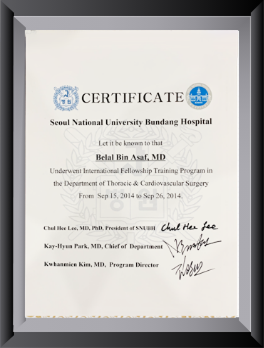
Director, Institute of Chest Surgery, Chest Onco-Surgery & Lung Transplantation — trained at AIIMS, New Delhi, with a Thoracic Surgery fellowship at Seoul National University Bundang Hospital, South Korea; first surgeon in India to perform a Robotic Subxiphoid Thymectomy. View full credentials & experience →


Morning: 10:00AM - 2:00PM
Evening 4:00PM - 6:00PM(Mon to Sat)


